Pages

03 December 2017

The meadow, wild garden and woods 2017.


 Looking across the small pond and meadow to the beehives, July 5th.

The honeybees (treatment-free / natural bee-keeping) continue to thrive. Here they are swarming on May 7th. They are in clear view from the kitchen window so even if I am indoors it's easy to see when they swarm.

Looking a little closer at the meadow, July 5th.

 Native orchid in the meadow June 16th.

 Ragged Robin in a damp part of the meadow June 16th.

Eucryphia, August 5th. If I named plants I would call this "The heaven for bees tree"!

This summer I realised that a branch on the weeping willow, planted about 17 years ago, had grown enough to hold a swing! August 5th.

Down near the big pond.

The meadow, August 5th.

Alfie collecting branches from summer pruning, August 13th.

Angus and Alfie raking...

...the hay from the meadow.

Alfie.

 September 13th.

Non-native Sika deer. Trouble for trees. Endearing. Brazen...   September 21st.

The view from the house... Sometimes.

Taxodium distichum November 8th.

September 29th. The fairy door we put by the tree, the toadstools grew!

05 November 2014

Wattle (our cat) on the beehives.


 Wattle and Daub, our cute kittens, are now nearly 6 months old, Daub has caught young rabbits, a young rat, and a good few mice.
 Wattle has caught mice ...

but hasn't caught any bees ...

... yet!
I trust the bees are well able to look after themselves and Wattle will soon learn, or give up.

Meanwhile, Daub has other ambitions! 

22 October 2014

Bee thoughts and Top bar hive update 2014


 I have read and researched about natural beekeeping and I confess that the more I know the less I know. (As is the way with so many things in life).
 I caught several swarms early in the summer, the early ones thrived, a couple of the later ones were small, I combined them as I had no more empty hives. 

July 22nd
 One of the days when I was watching a swarm emerge it moved straight into a neighbouring hive. The hive that was taken over by the swarm had swarmed a couple of times itself and if I had not seen the swarm move in, I would have thought that the old colony had simply recovered its strength very quickly. The observation windows have been great for anticipating swarms. The colony that was taken over definitely had bees resident prior to the swarm moving in.

July 22nd
 It has been an incredible year here for nectar flows. Although August was cool and wet, May, June, July, September and even some of October have had wonderful bee weather.  I took our first honey in July.

 It is SO fragrant. I don't eat much honey but I could enjoy the scent all day. It is reminiscent of a bouquet of flowers. (I am surely biased!).

 Having the bees here is such a joy, the honey is wonderful, trying to understand what is going on is .... challenging. Tuning in with instinct and going with their flow is my way.

October 16th
 However... The most significant element of this journey is how the bees have affected my gardening. Essentially I am a gardener. A hands in the soil person. Everyone has their vocation and while I love many crafts, growing and cultivating is in my being.

 Prior to homing the bees here we rarely saw a honey bee in the garden. Now every day I see them move around the garden from plant to plant, all through the year. So many of our ornamental "exotic" plant species are wonderful bee plants and I see a whole new value in their place in the garden, and I don't mean the value of the honey crop, I mean the value of nectar and pollen as a food source for not just honey bees.

The bees have awoken in me a deeper appreciation for all plants.

27 June 2014

Birds nest in the bait hive.


We took the bait hive down from the eaves of the barn in April and it was filled with moss and horse hair! We forgot to put a nail across the entrance hole to make it too small for birds!  We put the box straight back up and saw a great tit going in and out a few times over the next few weeks.

  Then on June 22nd I was going into the small tunnel when I heard bees buzzing! The bees spent all afternoon trying to decide if this would make a good home, but there must have been competition from another suitable vacant hive. As evening came and the large swarm was still hanging in the crab apple tree I decided to put them in the hive Angus has recently built.

Angus took the bait hive down a couple of days later, cleaned out the nest and put a nail across the entrance so the birds won't be able to use it again. I did think that this was a very natural deep floor and probably what a swarm would often find in a suitable tree cavity.

16 October 2013

The bees ready themselves for winter.

After an eventful first season with bees it is time to wish them the best as they head into winter.
 
   
 Early morning dappled sun on the hive. It was 8.9C and the bees were busy! The cast swarms have time to make up. There are two hives, each with a colony at each end.  All 4 queens born this year.

 Ivy in flower, the last big nectar flow of the year.

 We are getting ready for winter too.

06 September 2013

Top bar Hives

I am beginning this bee keeping journey with top bar hives (TBH). 
 These are horizontal hives where the bees build their own comb.


 Hive with deep floor ready for bees to be transferred in.

  A few of the advantages of TBHs are that there is no heavy lifting, no buying frames of wax and they are cheap and easy to build. I am looking forward to trying other hive types where the bees can build their own comb in the future but I have enjoyed and learned a lot starting with TBHs.


 Inside one end of new hive.

Photo of a comb in June before swarming.

A comb from the July 8th swarm colony. Photo taken in early August.

Taking a photo of an end comb from a recent swarm.

 I have found great inspiration on the Natural beekeeping forum   biobees    where Angus found hive plans to make our first hive and I have found sage and friendly advice. We now have 2 hives fitted with deep floors which currently house 2 colonies each and one spare hive.

 The 2 hives each with a colony at each end.

09 August 2013

Moving bees


 I moved the little cast swarm that has been in a bait hive for the last 6 weeks a distance of about 20 feet to a permanent hive.

 Bee wisdom states that... "One should move a beehive fewer than three feet or over three miles", there are ways around this.


 I moved the bait hive to the new location when all the bees were home in the late evening. I placed a branch in front of their entrance to encourage the bees to re-orientate the following day.

The bees were given a couple of days to get used to their new location. There may be a few old bees who return to the old location and one can leave a box there to collect them, returning them to the new site in the evening but I found that unnecessary as the new hive was in view of the old location.

View of the bait hive entrance lined up with their new entrance behind. After adjusting to their new location the combs with bees are transferred into the permanent hive. 

 The hive ready to receive the combs. Another colony is undisturbed at the other end of the hive.
While transferring the combs I took the opportunity to take a few photos.

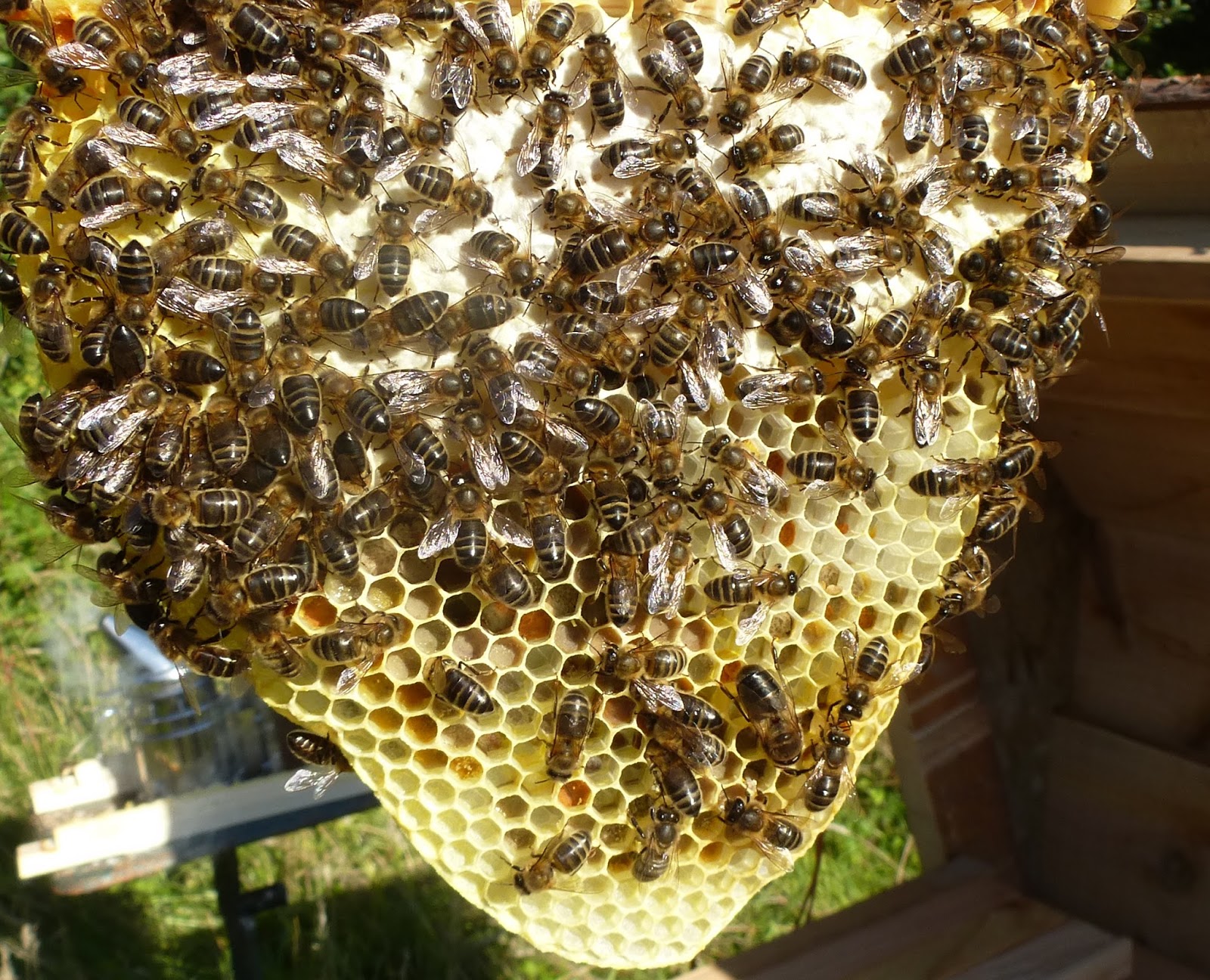
This comb is filled with colorful pollen and capped honey on top.

This comb has pollen on the right, Honey on top, brood and larvae.

A good view of their capped brood.

Here they are in their finished hive.
They were amazingly good natured about the move.

 Edited to add, These bees overwintered successfully and have continued to thrive. 

27 July 2013

July swarm.


Our friend Eric gave us a nucleus colony of bees on May 26th. Eric even helped with the transfer into the top bar hive which meant cutting the combs to fit (poor bees)!
 The weather has been exceptionally good since then and on July 8th this colony swarmed.

It is hard to see in this photo but here the bees are swarming.

 The swarm in the bottle brush / Callistemon shrub.

 I put them in this 30 litre bait hive but they did not seem settled.
I transferred them after 2 or 3 hours into an unfinished top bar hive.
They were very happy with this.

-------------------------------------------------------------------------------------------

   One of the most interesting aspects I am discovering as a new beekeeper is sensing the mood of a colony based on their sound. It is amazing how effectively bees communicate by the tone of their buzz. A swarm is a most magical sight and sound. As they have no hive, no brood and no honey to protect they have a very  gentle nature. The sound of a swarm is a deeply harmonious hum.
(A swarm that is a few days old and not found a home yet could be in a different mood though).

 Looking in the window after 6 days,

 After 14 days I moved them into a finished top bar hive.
This is one of their  combs pictured in the old hive during the transfer.

This is one of their combs after being placed in their new hive.
They built 13 combs in 14 days.

Tivon watching the entrance after helping to transfer another colony into another finished hive.


Honey bee on poached egg plant in June. They loved this plant.


Swarm at Honeyoak. June 2013.
A swarm like this which has just landed is like a new baby, and to be honest, I could hardly have been more excited!


The bait hive was waiting in the eaves of the barn in case I had missed seeing the swarm....


I brought the bait hive down to the swarm as we don't have another hive ready yet.
The branch they were on is cut and gently placed into the bait hive.

---------------------------------------

 Here is the little swarm settling in to their new home.

After 2 weeks I take a look at the first few combs and see brood, This means that the virgin queen that came with the swarm has mated successfully.
This is a wonderful start!


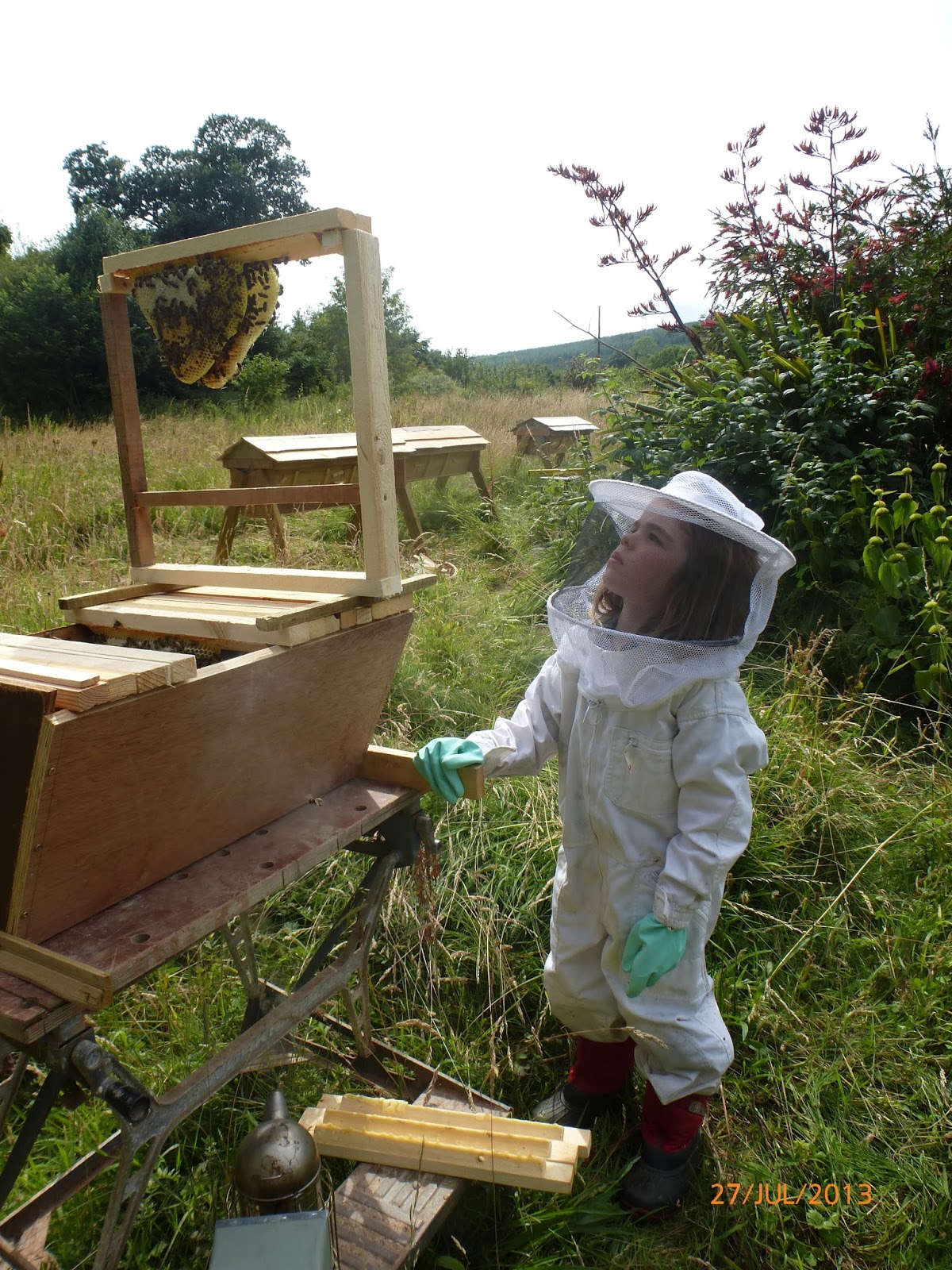
Our friend Mike gave us a loan of a bee suit in Tivons size, (as well as the loan of his hive while he is away).
Unfortunately we have made the bees a bit cross with some of the moving around so the bee suit has been useful.
Tivon looking at 2 combs from the little swarm. They are still in a bait hive.

Edit .... All the colonies and swarms in 2013 built up well and successfully overwintered, going on to swarm themselves the following year.


The hives outside the kitchen window.

 Angus has been busy building all 3 hives and 2 bait hives these last couple of months. The materials for the 3 main hives cost 50 euro each. Most of the cost was the 1 inch thick dry cedar from our local sawmill for the hive body and the roof pieces. Angus used odd bits of timber that we already had for the rest of the hive.
 

 The 2nd finished top bar hive, 2 periscope entrances and deep floor.


The 3rd finished top bar hive with periscope entrance!

Looking inside at the deep floor before it is filled.

Looking underneath at the exterior finish of the deep floor.

Looking inside the 2nd hive with deep floor, filled with chipped apple and hazel branches.
This was just before we moved the bees in.


The pond, levels are down with the drought but the bees are loving the good weather.