Pages

19 July 2016

Spring bees, Summer swarms and flowers.


A few photos of the bees in the garden today (25.9 deg.C here today and there is the scent of honey in the air), a few swarm photos and a few photos taken in the spring.... An overdue bee-update!

Honeybee on Inula hookeri today, July 19th.

Honeybee en-route to Sweetpea.

July 19th

The honey bees have been all over the Stachys byzantina / Lambs ears.


 The Rosebay Willowherb in the edible-woodland garden is a flower-forest ...


...thrumming with bees. July 19th.

Eucryphia lucida 'pink cloud', although looking a little faded....

 .... is a mass of blossom covered in honeybees, bumblebees and hoverflies July 19th.
 
Our first swarm this year was on May 27th.

Here they are arriving in the new home of their choice on May28th.

This is another swarm on June 12th.

Moving themselves into a bait hive placed on the picnic bench at the deck.

The bait hive is a small light portable hive with some old brood comb inside to attract a swarm.

Once all the bees are settled into the bait hive...

...the bait hive can be moved to the location of their final home.

It was one month later, on July 12th, before I found a suitable day to transfer this same colony of bees into their permanent hive.
They had been busy raising brood and building comb, time yet to gather honey for the winter.

 To free up one hand for the camera one side of the topbars had to be propped on the side of the hive, then I took a couple of blind photos mid-transfer, good natured young colony had such a gentle hum all the time.

The swarms this year have been abundant and we have been able to share swarms.
 Thankfully we are at home to see the emerging swarms and collect them, as well as having the back-up bait hives.
 -------------------------

Wild Pear blossom, April 14th.

 Back this spring the bees at Honeyoak were looking strong, with pollen pouring into the hives, building up after the winter. The bees have not been treated for Varroa (or anything else) since they came here more than 3 years ago. They don't get sugar in the autumn or fondant in the spring either, just a very loving gardener!

Viburnum x Carlcephalum?

Winter arrived late and lingered on, but all the colonies made it through. We had a little snow and plenty of hail in April, but the bees made the best of it and so did I. Pottering in the garden, cutting back, moving, dividing, planting, potting on, much of the time with the bees buzzing about nearby. Only occasionally do I stop and take out the camera to take pictures, So these are just a few of their spring plants this year....

Viburnum x Carlcephalum?  April 10th.

Camellia × williamsii 'Donation". There is a honeybee in there! April 10th.

 
Osmanthus Delavayi and a big orange pollen sack on this honeybee, April 10th.

Pollinating the Victoria plums, April 10th.

Pollinating the apricots March 9th.

Apricot blossom, they haven't cropped so well this year though, at least it is not from lack of pollination!

The Rosemary was covered in bees during any half decent weather while it flowered between October and May. In our garden it is the best and longest flowering winter /spring bee plant. Photo February 23rd.

 Erysimum Bowles mauve flowered all winter long, it flowers all spring, summer and autumn too,  (I admit I am actually starting to tire of its endless flowering! I chopped a couple of plants right back, this will encourage more flowers but there may be time for their absence to renew my favour! ). The first honeybee visits that I saw to the Eriysimum were on February 23rd and have continued intermittently since.

 Honeybee on willow February 23rd.

Willow, a super source of pollen for the bees in spring, when the weather is not windy.

That completes our bee update from early spring to summer!

30 June 2015

June bees.


Our first swarm this year was on May 28th, It moved itself straight into a prepared hive. This one on June 5th landed conveniently on a stake right beside the bee hives.
The stake had been used to support the autumn raspberries last year.

Here the bees are gathering.

Once the swarm settled, the stake lifted easily with bees attached and the swarm was popped into a nearby hive.

Angus and Alfie looking at the swarm landing on the stake on the left of photo.


04 June 2014

Love Heart Swarm


Yesterday, June 3rd, another prime swarm, this one is heart shaped.
They settled more or less on the main trunk of a young plum tree.

  A couple of days ago I placed some old brood comb in a bait hive and on Monday there were several bees checking it out.

There was also a lot of bearding on the mother hive on Monday and I could see through the window how full the hive was becoming.
All possible indications of an impending swarm.

I shook the swarm down into a swarm-catching, light, plastic planter and tipped them into the bait hive which I moved down to the plum tree. I also picked handfuls of long grass to "sweep" the bees from the trunk into the plant pot. After the first lot were tipped in I closed up the roof and all the rest walked in though the hive entrance.

This spring I am observing rather than preventing the natural behaviour of the bees. (Although I have prevented the swarms from choosing their hive). I am keen to build a small apiary of several colonies so that I can compare the different options of working with bees. I am looking to find the best approach that will be bee-friendly while also yielding honey, without the conventional approach of sugar feeding the bees after the honey harvest.

A swarm of bees in June.....  Hum a very merry tune!
The sound of a swarm is so harmonious. The swarm has such a perfect cohesive sense of purpose and every bee is humming that same sweet song.

13 May 2014

A swarm of bees in May...

....a new colony begins in the happiest way.
May 12th
The little swarm from June last year swarmed yesterday. This is the activity at the hive just before 2pm.

The photos do not capture all the bees in the air and the wonderful hum.

 
I cut the leaf and took this photo just before shaking the bees into the hive.
The colony from which this swarm came have a lovely temperament.

 
There were still lots of bees on the leaf, outside the hive and in the air, but the queen must have been in the hive as all the bees went into the hive with impressive efficiency.

The sun went in and dark clouds rolled over just as the last few bees went in. The heavens then opened with a torrential downpour of rain followed by..

  Hail! (This photo is of the hail on the deck, when the bees and I were safely homed).

By evening all is happy and calm, (yes, it is a temporary roof!)

 A new colony begins......

27 July 2013

July swarm.


Our friend Eric gave us a nucleus colony of bees on May 26th. Eric even helped with the transfer into the top bar hive which meant cutting the combs to fit (poor bees)!
 The weather has been exceptionally good since then and on July 8th this colony swarmed.

It is hard to see in this photo but here the bees are swarming.

 The swarm in the bottle brush / Callistemon shrub.

 I put them in this 30 litre bait hive but they did not seem settled.
I transferred them after 2 or 3 hours into an unfinished top bar hive.
They were very happy with this.

-------------------------------------------------------------------------------------------

   One of the most interesting aspects I am discovering as a new beekeeper is sensing the mood of a colony based on their sound. It is amazing how effectively bees communicate by the tone of their buzz. A swarm is a most magical sight and sound. As they have no hive, no brood and no honey to protect they have a very  gentle nature. The sound of a swarm is a deeply harmonious hum.
(A swarm that is a few days old and not found a home yet could be in a different mood though).

 Looking in the window after 6 days,

 After 14 days I moved them into a finished top bar hive.
This is one of their  combs pictured in the old hive during the transfer.

This is one of their combs after being placed in their new hive.
They built 13 combs in 14 days.

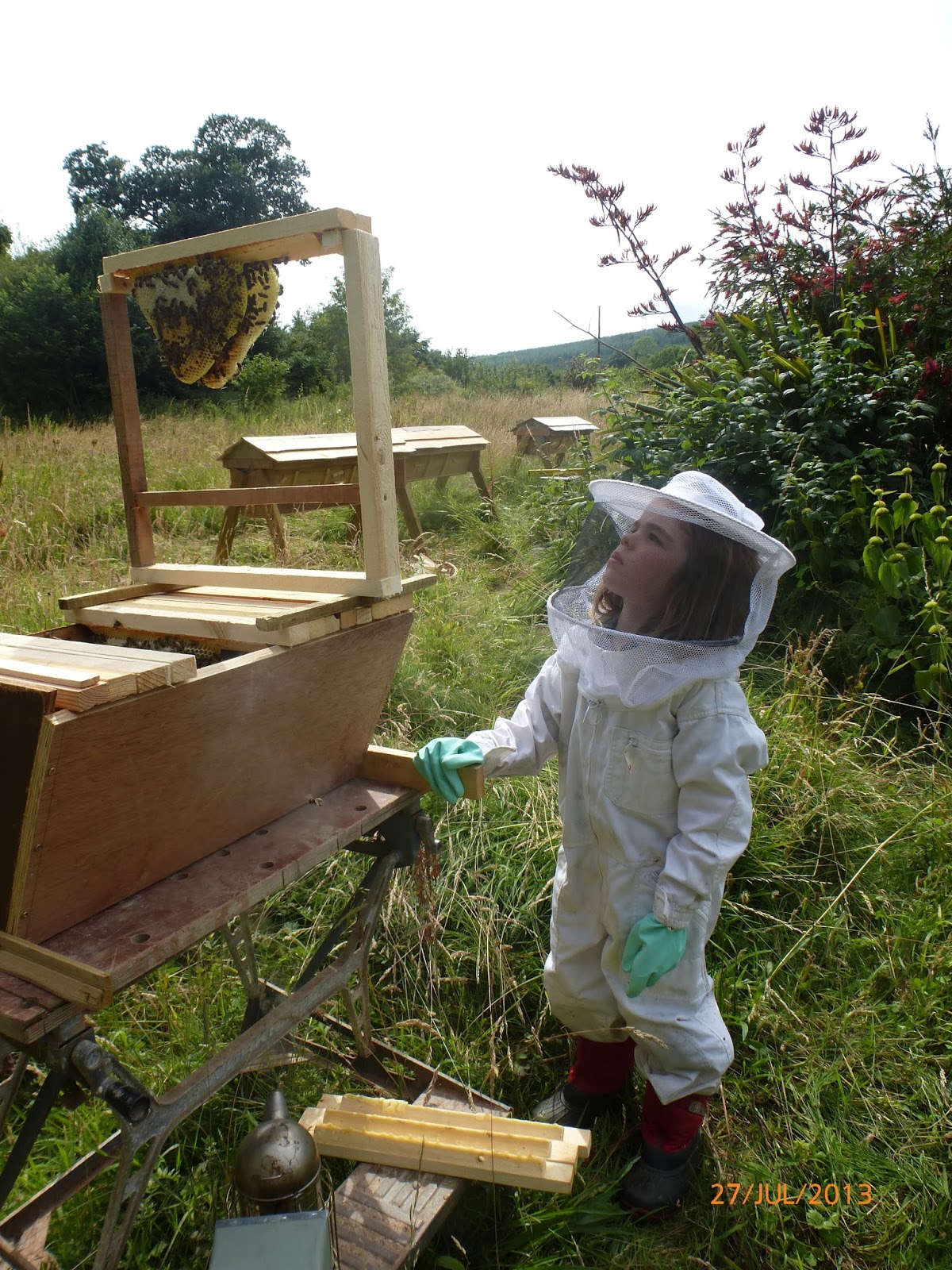
Tivon watching the entrance after helping to transfer another colony into another finished hive.


Honey bee on poached egg plant in June. They loved this plant.


Swarm at Honeyoak. June 2013.
A swarm like this which has just landed is like a new baby, and to be honest, I could hardly have been more excited!


The bait hive was waiting in the eaves of the barn in case I had missed seeing the swarm....


I brought the bait hive down to the swarm as we don't have another hive ready yet.
The branch they were on is cut and gently placed into the bait hive.

---------------------------------------

 Here is the little swarm settling in to their new home.

After 2 weeks I take a look at the first few combs and see brood, This means that the virgin queen that came with the swarm has mated successfully.
This is a wonderful start!


Our friend Mike gave us a loan of a bee suit in Tivons size, (as well as the loan of his hive while he is away).
Unfortunately we have made the bees a bit cross with some of the moving around so the bee suit has been useful.
Tivon looking at 2 combs from the little swarm. They are still in a bait hive.

Edit .... All the colonies and swarms in 2013 built up well and successfully overwintered, going on to swarm themselves the following year.


The hives outside the kitchen window.

 Angus has been busy building all 3 hives and 2 bait hives these last couple of months. The materials for the 3 main hives cost 50 euro each. Most of the cost was the 1 inch thick dry cedar from our local sawmill for the hive body and the roof pieces. Angus used odd bits of timber that we already had for the rest of the hive.
 

 The 2nd finished top bar hive, 2 periscope entrances and deep floor.


The 3rd finished top bar hive with periscope entrance!

Looking inside at the deep floor before it is filled.

Looking underneath at the exterior finish of the deep floor.

Looking inside the 2nd hive with deep floor, filled with chipped apple and hazel branches.
This was just before we moved the bees in.


The pond, levels are down with the drought but the bees are loving the good weather.