Pages

31 December 2015

Beeswax and mead.


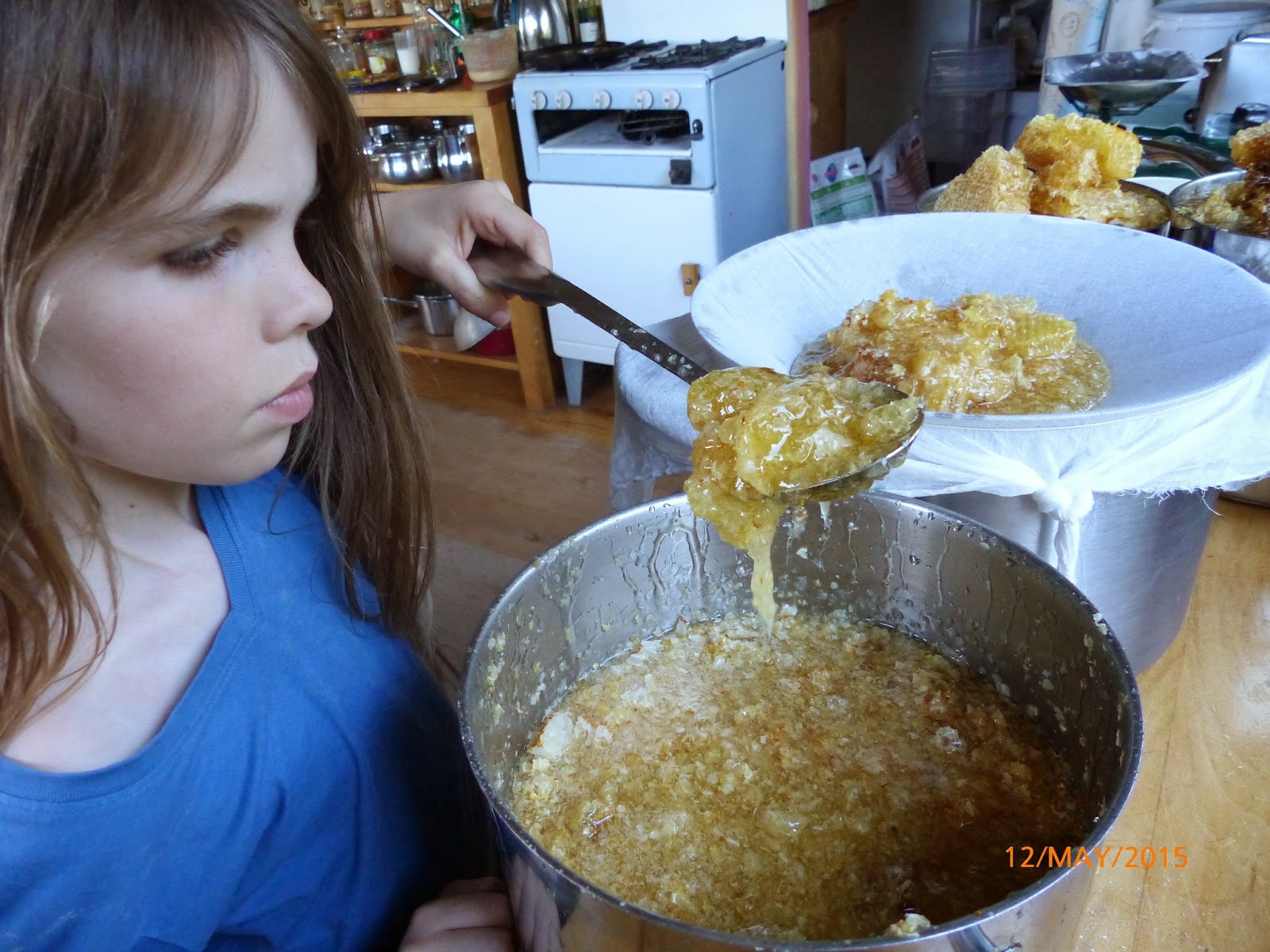
Tivon concentrating while spooning crushed honey comb last May.

It might be quicker to pour, but I'm happy if Tivon chooses to do it one spoonful at a time.

Next morning the honey has drained through and it is mostly wax left in the muslin.

As in this photo, I started  to pour the honey into jam jars but I ran out after filling about 50, the remaining honey went into a few gallon Kilner jars. (There were a few of pot fulls).

I found myself with some ivy honey crystallized in the comb in November and after gently melting as much as I could in a bain marie to extract as much honey as I could, I decided that making mead was probably the best option for the rest of it.

As well as the honey and water I added the juice of a lemon. I also simmered several handfuls of crab apples in a little water and added the liquid after straining and cooling.
The demijohn proceeded to bubble profusely for a couple of weeks, in this photo it has just been racked off.

After a few more weeks settling down in the demijohn it is racked off into bottles. I had never tasted mead before, but after leaving it to mature in bottles for a few months I tried it and thought it was excellent.

 With the wax left over after straining the honey I rendered small quantities (about 8oz+ each) of beeswax at a time from different batches of comb. The selection of colours represent the age of comb, with the older comb containing more propolis hence the richer colour. The small quantities are easier to break into pieces for adding specific quantities to recipes. A large solid block of beeswax is hard to cut!

16 January 2014

Beeswax Candles

 
 We had so much fun with the colours to add to the beeswax that we dipped candles again on new years day and for the following week.

The dipping pots and glasses are now put away until next winter. I thought the kitchen counter top space would be clear again , it was,  for a couple of hours. Seed sowing time has come round again and the kitchen doubles as a little nursery. The counter tops are already shrinking to make way for seedling trays!

29 December 2013

Soap making

I made several batches of soap in November and December, here are some photos I took along the way.
 
Organic coconut oil, olive oil and home rendered bees wax are melted together.
Lye is added to make the soap base to which extras can be added.

Adding cream, oats and honey to one batch.

Pouring a batch of poppy seed soap into moulds.

First batches of milk soap curing.

Freshly picked Calendula petals drying.

Dried Calendula petals added to soap.

Zoe pouring soap into moulds, a swirly batch in the foreground.

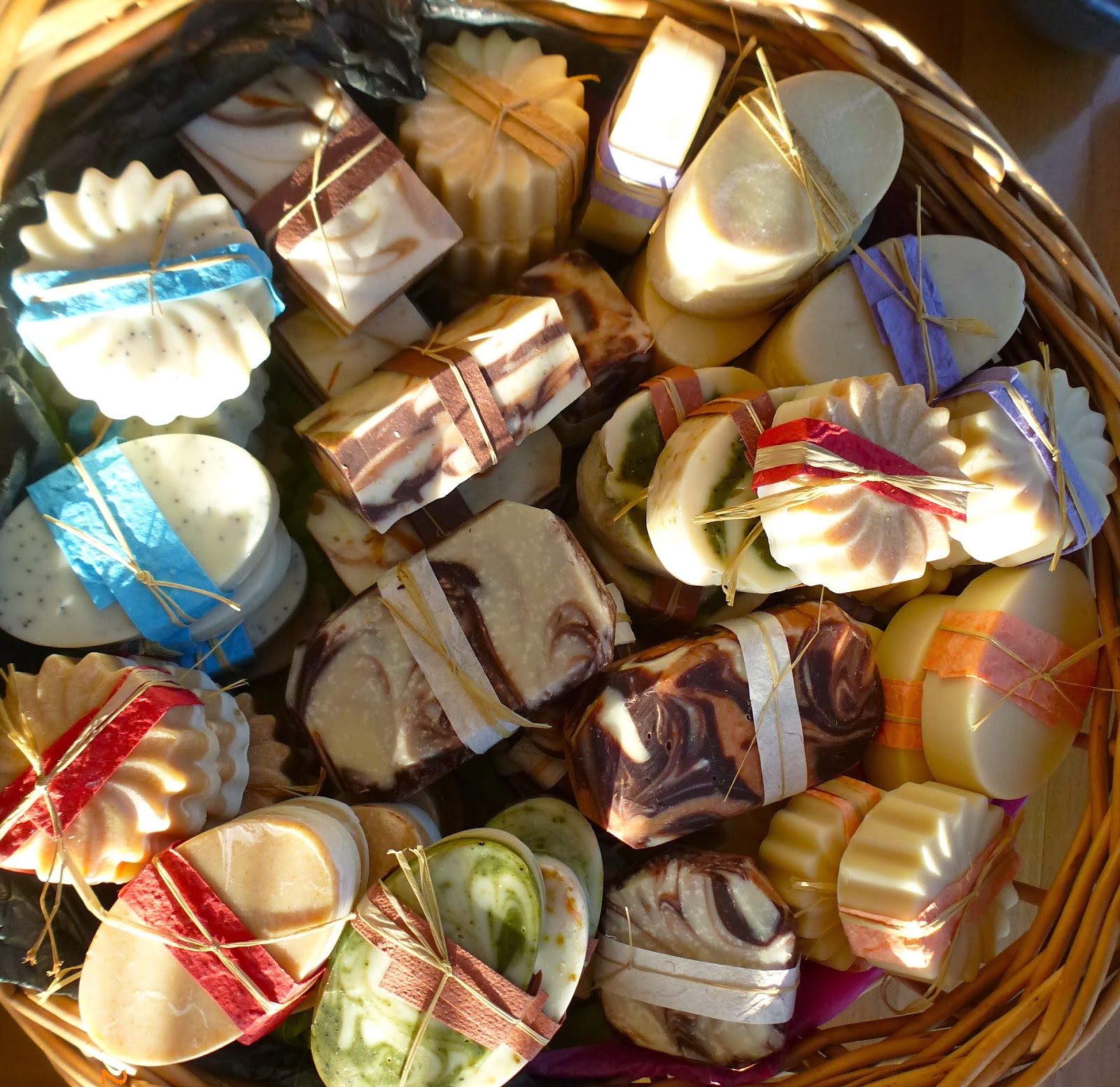
 Finished Soaps.

14 November 2013

Beeswax candles

Finished candles, I like the bendy ones.

 As soon as the wood-fired range goes on in the autumn the requests come "when can we dip candles?"
All day the beeswax melts on the range and evenings are spent dipping.

 It is a wonderful activity for wet dark days, but the light is not good for photos.

 This year we have 6 colours to add to the beeswax.


19 October 2013

Bee's wax

My Sister Jacqui gave me Larry's bee's wax cappings and I am delighted!

This wax is from the caps of the cells and is collected when the caps are cut off in preparation for extracting the honey from framed combs in national hives. (With top bar hives usually the whole comb is harvested).

Here it is being melted with water....

 .... and strained.

  8 oz beeswax. I will use it as an ingredient in soap making.

The bees at Honeyoak have spent this season building their homes and building their numbers so I did not harvest honey this year. I intend to use a simple solar wax melter when I hopefully have lots of honey, and thus beeswax, in years to come. Live in hope!